
TL;DR
Cloudflare Developer Platform has a simple pricing model: generous free tier, flat $5/month Paid plan with generous bundled quotas, overflow billed per-unit at rates cheap compared to AWS. Egress is $0.
Main thesis:
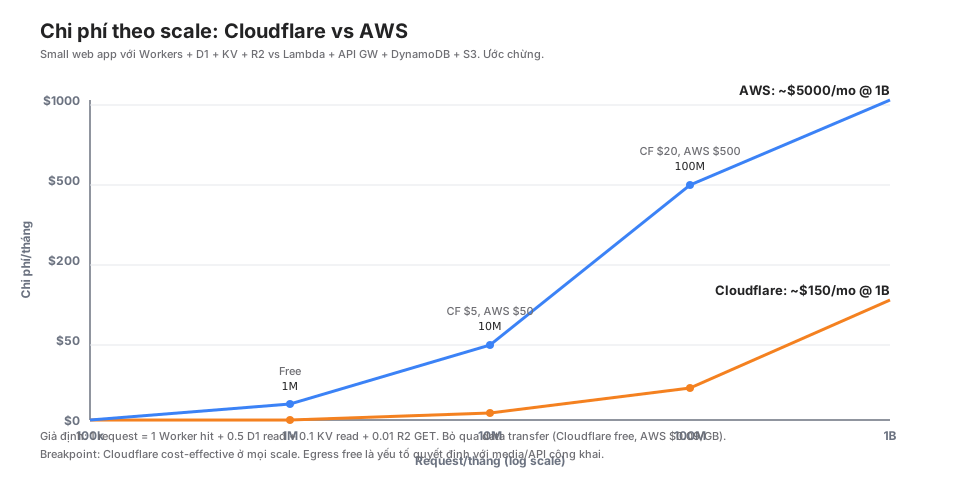
Cloudflare is cheaper than AWS on 3/4 typical primitives (Workers, D1, R2) and similar on 1/4 (KV vs DynamoDB, Queues vs SQS). But the decisive advantage is zero egress and no idle infrastructure cost. For apps < 100M requests/month, usually 5-20x cheaper than AWS. For > 1B, still 10-30x cheaper — mainly thanks to egress and no idle cost.
This post covers: per-primitive pricing in detail, 3 real scenarios (blog, 10k-user SaaS, 100M-req app), breakpoints when the Paid tier is worth it, and when AWS is actually cheaper than Cloudflare.
Who this is for
- Developers building a side project who need a rough cost idea.
- Startup teams evaluating migration from AWS.
- Finance / engineering managers estimating budget for a platform choice.
Recommended prerequisites: Part 1 (overview), Part 13 (Workers AI pricing).
By the end of this post you will:
- Estimate monthly cost for your app in under 15 minutes.
- Know the breakpoints for moving from Free to Paid, and Paid to Enterprise.
- Identify when cost optimization is worth the effort, and when it isn’t.
What this post isn’t about
- Enterprise pricing in depth: custom bulk discounts, not public. Talk to sales.
- Cost alert setup: covered in Part 17 (Analytics Engine + Notifications).
- Comparison with Vercel, Netlify, Railway: focus is AWS, the most common serverless benchmark.
Per-primitive pricing
Workers (compute)
Free tier:
- 100k requests/day (≈ 3M/month).
- 10ms CPU time per invocation.
Paid plan ($5/month):
- 10M requests/month included.
- 30s CPU time per invocation.
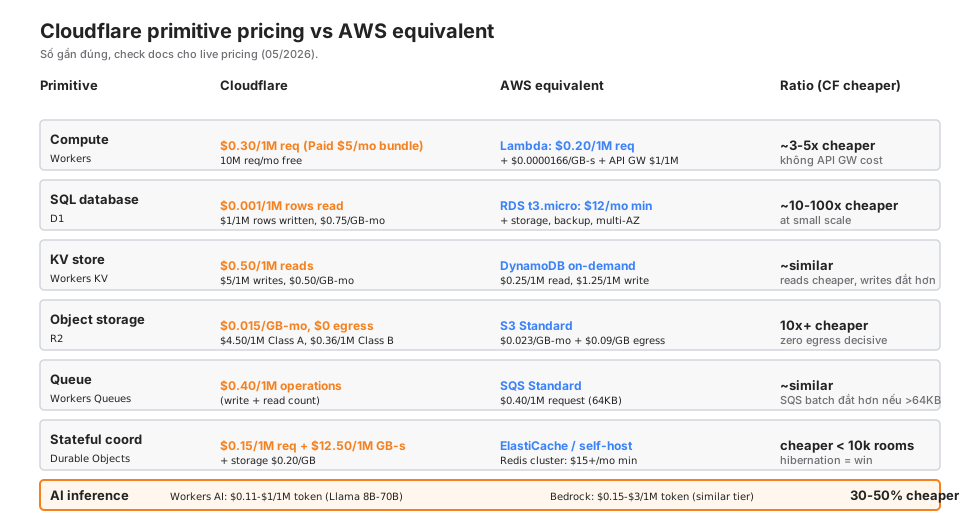
- Overflow: $0.30 per 1M requests + $0.02 per 1M CPU-ms above 30ms.
vs AWS Lambda:
- Lambda: $0.20/1M requests + $0.0000166/GB-s.
-
- API Gateway: $1/1M requests (REST) or $3.50/1M (HTTP API).
Workers $0.30/1M vs Lambda+APIGW $1.20-4.20/1M = 3-14x cheaper.
D1 (SQL database)
Free tier:
- 5M rows read/day, 100k rows written/day.
- 5GB storage.
Paid plan (included in the $5 bundle):
- 25B rows read/month, 50M rows written/month.
- 5GB storage.
Overflow:
- $0.001 per 1M rows read.
- $1 per 1M rows written.
- $0.75 per GB-month storage.
vs DynamoDB on-demand:
- $0.25/1M reads (eventually consistent), $1.25/1M writes.
- $0.25/GB storage.
D1 reads are 250x cheaper than DynamoDB. Writes are similar. Storage is 3x more expensive than DynamoDB (but anyone using > 10GB has already migrated off D1).
vs RDS (small instance):
- t4g.micro: $12/month minimum (not counting storage, backup, multi-AZ).
- Vertical scaling gets expensive fast.
D1 < $1/month for a blog, $10-30/month for typical SaaS. RDS minimum = $12/month for an idle dev database.
KV (key-value)
Free:
- 100k reads/day, 1k writes/day.
- 1GB storage.
Paid:
- 10M reads, 1M writes /month included.
- Overflow: $0.50/1M reads, $5/1M writes, $0.50/GB-month.
vs DynamoDB:
- Reads: KV 2x cheaper ($0.25 vs $0.50).
- Writes: DynamoDB 4x cheaper ($1.25 vs $5).
KV is eventually consistent. Use for cache, config, flags. Not for transactional data.
R2 (object storage)
Free tier:
- 10GB storage.
- 1M Class A operations (PUT, POST, LIST).
- 10M Class B operations (GET, HEAD).
Paid:
- $0.015/GB-month storage.
- $4.50/1M Class A operations.
- $0.36/1M Class B operations.
- $0 egress.
vs S3:
- $0.023/GB-month storage.
- $5/1M Class A, $0.40/1M Class B.
- $0.09/GB egress (US, outbound internet).
R2 is 50% cheaper on storage. The egress difference is decisive for media/public APIs.
Example: 1TB R2 storage + 10TB egress/month = R2 $15 vs S3 $923 ($23 + $900). ~60x cheaper.
Queues
Free:
- 1M operations/month.
Paid:
- 100M operations/month included.
- $0.40/1M additional.
vs SQS:
- $0.40/1M requests (64KB).
- Larger messages → multiple billing units.
Even. No major advantage or downside.
Durable Objects
Free: limited, typically 1M requests/day + small duration.
Paid:
- $0.15/1M requests.
- $12.50/1M GB-s duration (while DO is active).
- $0.20/GB-month storage.
- Hibernated WebSocket: $0 duration, storage only.
Comparison: no direct AWS equivalent. Closest = ElastiCache Redis cluster ($15-50/month minimum) + custom coordination code.
1000 active chat rooms: ~$2/month on DO vs $15+/month on Redis. 8x cheaper.
Vectorize
Paid:
- $0.04/1M dimensions stored/month.
- $0.01/1M dimensions queried.
vs Pinecone:
- $70/month minimum (p1.x1 starter).
- Per-namespace quota.
Vectorize scale-to-zero pricing. Pinecone requires a commitment. 10-70x cheaper at small scale.
Workers AI
Free: 10k neurons/day.
Paid: the $5 bundle includes a neuron allocation.
Per-model pricing (example):
- Llama 3.1 8B: $0.11/1M input tokens.
- Llama 3.3 70B: $0.40/1M input.
- bge-m3 embeddings: $0.012/1M tokens.
- Flux schnell: $0.005/image.
vs Bedrock Claude Haiku: $0.25/1M input. Workers AI Llama 8B same tier = 2x cheaper.
Frontier models (GPT-4, Claude 4.7, Gemini 2.5 Pro) have no Workers AI equivalent.
Scenario 1: personal blog
Setup: Astro static blog + a Worker for the subscribe form + Workers AI for popular-posts recommendations.
Traffic:
- 50k page views/month.
- 200 form submissions/month.
- 2k AI suggestion calls/month.
Cloudflare cost:
| Service | Usage | Cost |
|---|---|---|
| Workers (Paid plan) | 100k req (page + api) | $5 (included) |
| Workers Assets (serving HTML) | 50k | $0 (in bundle) |
| D1 subscribers table | 200 writes, 50k reads | $0 |
| R2 cover image | 500MB, 200k fetches | $0.01 |
| Workers AI Llama 8B | 2k calls × 500 tokens | $0.10 |
| Vectorize | 1000 vectors × 1024 dim | $0.04 |
| Total | $5.15/month |
AWS equivalent:
| Service | Usage | Cost |
|---|---|---|
| Lambda | 100k req | $0.02 |
| API Gateway | 100k req | $0.10 |
| CloudFront + S3 | 50k pages × 100KB = 5GB | $0.45 |
| DynamoDB | 250 writes, 50k reads | $0.05 |
| S3 image | 500MB, 200k GETs | $0.09 |
| Bedrock Claude Haiku | 2k calls | $0.50 |
| OpenSearch (vector) | minimum $50/month | $50 |
| Total | $51.21/month |
Cloudflare 10x cheaper thanks to the bundle + no minimum instance.
Pure free tier?
If you skip Workers AI + Vectorize: Cloudflare is $0/month end-to-end.
Key insight
A personal blog is free or $5 total on Cloudflare. AWS minimum is $50+ because of OpenSearch + even a tiny DB instance.
Scenario 2: SaaS startup with 10k users
Setup: a SaaS todo app + admin dashboard + mobile API.
Traffic:
- 1M API requests/month.
- 100k user actions/day = 3M D1 writes/month.
- 30M D1 reads/month.
- 100GB R2 (user uploads) + 200GB egress.
- WebSocket chat, 1000 concurrent avg (Durable Objects + Hibernation).
Cloudflare:
| Service | Usage | Cost |
|---|---|---|
| Workers Paid | 1M req | $5 (included) |
| D1 | 30M reads (free in bundle), 3M writes | $3 (2M overflow × $1/1M) |
| R2 storage | 100GB | $1.50 |
| R2 egress | 200GB | $0 |
| R2 ops | 500k Class B | $0.18 |
| Durable Objects | 1000 rooms × 1h active/day | ~$5 |
| Total | ~$14.70/month |
AWS:
| Service | Usage | Cost |
|---|---|---|
| Lambda | 1M req | $0.20 |
| API Gateway | 1M req | $1 |
| DynamoDB | 30M reads, 3M writes | $11.25 |
| S3 storage | 100GB | $2.30 |
| S3 egress | 200GB | $18 |
| S3 ops | 500k GETs | $0.20 |
| ElastiCache t3.small Redis | min 1 node | $50 |
| Socket.io on EC2 t3.small | 1 instance | $15 |
| Total | ~$98/month |
Cloudflare ~7x cheaper. Egress is the big factor (200GB = $18 AWS, $0 CF).
Scenario 3: 100M requests/month app
Setup: API-heavy service, AI features, media upload.
Traffic:
- 100M Worker requests.
- 500M D1 reads, 50M writes.
- 1TB R2 + 10TB egress.
- 10M Workers AI calls (Llama 8B).
- 5M Vectorize queries.
Cloudflare:
| Service | Usage | Cost |
|---|---|---|
| Workers | 100M req (10M free, 90M × $0.30/1M) | $27 |
| D1 | 500M read free, 50M write × $1/1M | $50 |
| R2 storage | 1TB | $15 |
| R2 egress | 10TB | $0 |
| R2 ops | 10M | $3.60 |
| Workers AI | 10M × 500 tokens × $0.11/1M | $550 |
| Vectorize | 5M queries × 1024 dim × $0.01/1M | $51 |
| Total | ~$696/month |
AWS:
| Service | Usage | Cost |
|---|---|---|
| Lambda | 100M req | $20 |
| API Gateway | 100M req | $100 |
| DynamoDB | 500M reads, 50M writes | $188 |
| S3 storage | 1TB | $23 |
| S3 egress | 10TB (past the tier) | $900 |
| Bedrock Claude Haiku | 10M × 500 tokens | $1250 |
| OpenSearch m6g.large (vector) | 1 node | $150 |
| Total | ~$2631/month |
Cloudflare ~4x cheaper. Egress + AI are the biggest savings.
Breakpoint: when to enable Paid
Cloudflare’s free tier is generous. Breakpoints for flipping on the Paid plan ($5/month):
- Workers observability enabled — free plan has limited tracing.
- Cron triggers > 30s — free: 30s timeout, paid: 15 minutes.
- CPU time > 10ms/req — free limit, paid goes up to 30s.
- Requests > 3M/month — free cap.
- Using Workers AI — free neuron quota is small.
- Need R2 > 10GB — beyond free tier.
Flat $5/month Paid includes:
- 10M requests.
- 30s CPU time.
- 25B D1 row reads, 50M writes.
- 10GB R2 storage + ops.
- Workers AI neuron allocation.
Almost always worth it if you’re building a real app.
Enterprise: when?
- Advanced score-based Bot Management.
- Enterprise Logpush.
- Commitment discount (volume negotiated).
- Custom SLA.
- Dedicated support.
No fixed number. Typically when spend > $1000/month, contacting sales is worth it.
Cost optimization tips
① Sample observability
Workers Logs at $0.60/1M for 100M requests = $60/month. head_sampling_rate: 0.1 → $6/month.
② Cache aggressively
CDN caching is free. A /api/popular endpoint cached 1h = 10k hits → 10 misses/hour = 240/day vs 240k/day = 1000x cheaper.
③ Aggregate before writing D1
1M events/minute × 1-1 D1 writes = expensive. Buffer into KV / a Queue, aggregate in 5-minute batches → write 1 row instead of 1M rows.
④ R2 lifecycle rules
After 30 days, archive or delete R2 log files. Storage costs compound, nothing auto-cleans.
⑤ Workers AI cache
AI Gateway caches per-prompt. A similar-post recommendation cached 24h = 99% fewer calls.
⑥ Tier down KV
KV reads $0.50/1M. If data rarely changes: cache it in a module-level Worker variable for warm isolates. Free on cache hit.
⑦ Scheduled Workers instead of DO
DOs stay alive = cost. A Scheduled Worker invokes → short execution → idles. If you don’t need WebSockets, Scheduled can replace it.
When AWS is actually cheaper
Not always Cloudflare. Cases where AWS wins:
① Deep commitment discounts
Enterprise AWS deal with 3-year RI at 60% off → compute is cheaper.
② Data-intensive jobs
Spark + EMR for TB/day ETL. Cloudflare has no equivalent. Self-hosting on Workers doesn’t scale.
③ Specialized services
SageMaker custom model training, SES email, Route 53 advanced routing. AWS has broader breadth.
④ Long-lived processes
Workers don’t run 24/7. Need Redis pub-sub 365/7 → self-hosting on EC2 can be cheaper at high throughput.
⑤ Existing lock-in
Migration cost > savings. If an app has been on AWS for 5 years with 200 resources, migrating to Cloudflare doesn’t justify itself unless strategic.
Gotchas
① Free tier is daily, not monthly
Workers Free: 100k req/day, resets at UTC midnight. Burst traffic can burn quota in an hour → rate limit. Paid plan is more predictable.
② D1 write cost is subtle
$1/1M writes is cheap, but 1 UPDATE query touching 1000 rows = 1000 writes. Bulk updates aren’t one billed transaction.
③ R2 Class A is more expensive than Class B
PUT, LIST are 10x more expensive than GET. Don’t send batches of tiny PUTs — concat instead.
④ DO GB-s bill while active
The Hibernation API matters. No hibernation = 24h/day × 30 days = 2.5M GB-s × $12.5/1M = $31/month per DO. Hibernation cuts that 10-100x.
⑤ Egress isn’t free for external AI
Workers AI egress is free. OpenAI/Anthropic through AI Gateway: Worker → Gateway free. Gateway → Provider → Gateway free (Cloudflare network). Provider → user: charged if Cloudflare proxies, different if routed otherwise.
⑥ Vectorize dimension × count
Cost = dim × vectors × rate. 1M vectors × 1024 dim = 1B dimensions stored. Smaller dimension (bge-small 384) cuts cost proportionally.
⑦ Budget alerts
No built-in hard cap. 100x overflow still charges. Set up Notification cost alerts early (Part 17).
⑧ No reserved pricing
AWS RIs give 40-60% savings. Cloudflare enterprise is negotiated, not public. Small/medium teams don’t benefit.
15-minute estimate template
Not perfectly accurate, but catches 80%:
Workers: monthly_req / 1e6 × $0.30 (overflow after 10M)  → $X
D1: reads / 1e6 × $0.001 + writes / 1e6 × $1  → $Y
R2: storage_GB × $0.015 + ops / 1e6 × ($4.50 class A + $0.36 class B)  → $Z
Workers AI: tokens / 1e6 × $0.11 (Llama 8B)  → $W
Vectorize: dim_stored / 1e6 × $0.04 + query / 1e6 × $0.01  → $V
DO: active_GB_s / 1e6 × $12.50 + storage_GB × $0.20  → $U
Total ≈ X + Y + Z + W + V + U + $5 (Paid plan).
Compare AWS: similar but rates × 3-10x.
Production checklist
- Enable Paid plan ($5/month) if building a real app.
- Sampling observability tuned to traffic.
- Cache headers + CDN for static + cacheable API data.
- Log cost budget alerts (Notifications).
- R2 lifecycle rules for logs, expired backups.
- DO hibernation enabled for WebSockets.
- AI Gateway cache for LLM calls.
- Aggregate D1 writes (buffer + batch), not 1-1 per event.
- Embedding dimension as small as still gives quality (bge-base 768 instead of bge-m3 1024 if OK).
- Review cost monthly, identify unexpected spend.
- Scope API tokens by least privilege (Part 12) — reduce cost-abuse risk from leaked tokens.
Wrap-up
The Cloudflare developer platform is cheaper than AWS in most scenarios by 5-30x, mainly thanks to bundled includes + zero egress + no idle cost. For medium-scale blogs/SaaS, total < $50/month with room to spare. For 1B request/month apps, < $1000/month.
AWS still wins for specialized workloads, data-intensive batch jobs, and deep commitment discounts. But for edge-first apps, Cloudflare is the reasonable default.
Part 20 (final): Migration from AWS/Vercel to Cloudflare — practical playbook for moving Lambda → Worker, S3 → R2, DynamoDB → D1. Closes the series.